9 surprising things lower-middle-class people do in restaurants that reveal how others really see them
I’ve been noticing something for years now—and I’m curious if this resonates with you.
There’s this invisible dance that happens in restaurants. People order, they eat, they leave. But there’s so much happening beneath the surface that most folks never think about. The way we hold our fork. Where we put our napkin. How we signal the server. These tiny moments reveal so much about where we come from and how we move through the world.
I’m not saying any of it is wrong. That’s actually the opposite of what I believe. But I’ve watched people from different backgrounds navigate dining spaces in completely different ways—and I’ve realized that what feels natural to one person might signal something entirely unintended to another.
Here’s the thing: if you grew up in a certain way, you probably do some of these things without even thinking. And that’s okay. Most people are too caught up in their own meal to judge. But understanding why we do what we do? That’s actually pretty interesting.
Let’s get into it.
1. Studying the menu like it’s a final exam
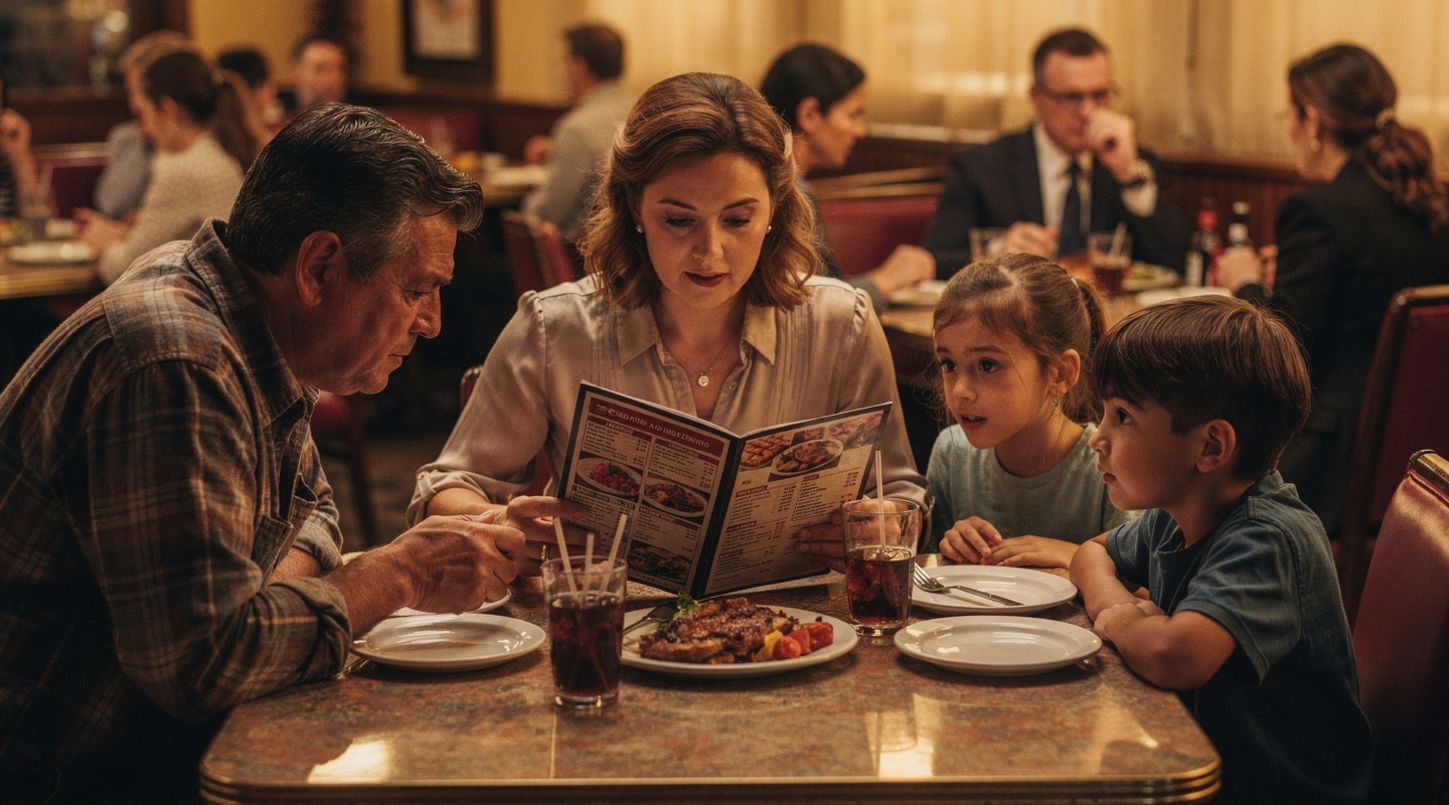
I’ve seen this countless times. Someone sits down, picks up the menu, and reads it with intense focus—line by line, top to bottom, sometimes even the specials board twice.
There’s nothing wrong with this. But I’ve noticed it’s often about something deeper than just indecision. When money has been tight at some point in your life, ordering out feels like a decision that matters. You want to get it right. You want to feel like you got your money’s worth.
Research in behavioral psychology suggests that our relationship with spending is deeply tied to our childhood experiences with scarcity or abundance. If you grew up watching every dollar, you’re probably going to approach that menu differently than someone who always had plenty.
The irony? Most servers barely notice. They’re just waiting for you to decide.
2. Ordering water without asking if it’s free
I did this for years. Automatically asking for tap water, sometimes even apologizing for not ordering something with a price tag.
My friend Sarah pointed this out to me once, and I felt a little embarrassed. But then I realized—I wasn’t being rude or cheap. I was being careful. When you’ve had to be mindful of every expense, you think about these things. You don’t want to assume anything costs money. You want to be sure.
People who grow up with financial stability often don’t even think about this. Water is just water. But for someone who’s been more careful with money, it’s a small thing that matters.
The psychology here is called scarcity mindset—and it’s not a character flaw. It’s an adaptation. It kept you safe once.
3. Eating quickly and efficiently
Here’s something I’ve observed: some people eat like they’re racing the clock, even when there’s no rush.
I used to do this. Fast, efficient, no wasted movement. No lingering over the plate. I thought everyone ate like this until I noticed my partner’s approach—she savored each bite, put her fork down between bites, made conversation the priority over the meal.
When you grow up in households where mealtimes are brief—maybe because people are working multiple jobs, or there are a lot of mouths to feed, or you just learned to be efficient—eating becomes functional. It’s fuel. Not an experience to stretch out.
Behavioral researchers have found that our eating pace is often shaped by our early family dynamics, not by our current circumstances. Even when I don’t need to rush anymore, I still do. The habit is in my body.
4. Not making eye contact with the server or asking for things quietly
This one hits different. I’ve caught myself doing this and then immediately felt frustrated with myself.
There’s something about not wanting to be a bother. Not wanting to take up too much space. Asking for refills in a small voice. Avoiding the server’s gaze because you don’t want to seem demanding.
It’s not shyness, necessarily. It’s about not wanting to be perceived as high-maintenance or difficult. And honestly? It often comes from a place where you learned that being visible or vocal could be risky.
“Our behavior in social spaces reflects the internalized messages we received growing up about our worth and our right to take up space.” – Dr. Lisa Wade, Sociologist
The server doesn’t experience this as polite. They experience it as distant. They can’t read your need if you won’t signal it.
5. Complimenting the food profusely or being overly grateful
I’ve done this. And I’ve watched others do it too. Someone brings the plate, and there’s this rush of genuine gratitude—maybe even more gratitude than the situation technically calls for.
It’s not fake. The food is good. The service is appreciated. But there’s often an undertone of relief. Relief that it’s good. Relief that we’re being treated well.
When someone has been dismissed or underserved before—by restaurants, by systems, by society—sometimes just being treated with basic respect and receiving a decent meal feels like more than expected. So the gratitude overflows.
Emotional reciprocity is a real thing. When someone does their job well and treats you with kindness, and you weren’t sure if they would, that hits differently.
6. Choosing the cheaper items even when you could afford the expensive ones
This is subtle. The menu has options ranging from $14 to $32, and you automatically zero in on the lower price points, even if you have the money today.
I still do this. And I’ve had to actively work against the voice that says I should order the cheaper thing. That I should be grateful for the less expensive option. That the expensive thing is somehow not for me.
Your brain learns patterns early. If the pattern was scarcity, even abundance doesn’t always reprogram that instantly.
There’s actually psychological research on something called the “scarcity effect”—where your brain stays in conservation mode long after the threat has passed. It’s a survival mechanism that sometimes overstays its welcome.
Related: How your childhood money memories still control your decisions today
7. Sitting in a slightly uncomfortable position to take up less space
This one’s physical. I’ve noticed people sometimes sit at odd angles in a booth, or they hunch slightly forward, or they keep their arms close to their body, even when there’s plenty of room.
It’s about not sprawling. Not claiming the space. Making yourself compact.
There’s deep body language psychology here. The way we position ourselves reflects how much room we believe we deserve to take up. And if you grew up in tight spaces—literally tight apartments or figuratively tight family dynamics where you needed to be small—your body remembers.
Even now, in restaurants with plenty of space, that muscle memory remains.
8. Not sending food back when something is wrong
I’ve sat across from people eating a cold meal or a wrong order, just because they didn’t want to cause a fuss.
And I used to do this too. Something would be off, and I’d just accept it. Maybe convince myself it was fine. Definitely not want to inconvenience the server by asking for a correction.
The underlying message? My comfort is less important than the server’s convenience. My satisfaction is less important than not being perceived as difficult.
It’s not about being nice. It’s about something deeper—a learned sense of hierarchy where your needs aren’t quite as valid as someone else’s workflow.
9. Splitting the check obsessively or offering to pay for everything
There’s no middle ground sometimes. Either someone is meticulously splitting everything down to the penny, or they’re insisting on paying for the whole group because they can’t tolerate the discomfort of being treated.
Both come from the same place: an uncomfortable relationship with receiving or with debt. The penny-splitter doesn’t want to owe anyone anything. The all-payer wants to ensure they’re never in the position of being treated as less-than.
Psychologists call this reciprocity anxiety—the stress we feel when we can’t immediately balance an exchange.
What this all means
Here’s what I want to say: none of these things make you less than. They make you human. They make you someone who learned strategies for survival, and now those strategies live in your body even when you don’t need them anymore.
The beautiful part? Once you see it, you can choose differently. You can sit up straighter. You can make eye contact. You can send the food back.
But you don’t have to. Sometimes these little gestures are just part of who you are, and that’s okay too.
What matters is knowing that you have a choice.