7 surprising things working-class boomers still display in the living room that reveal more than they know
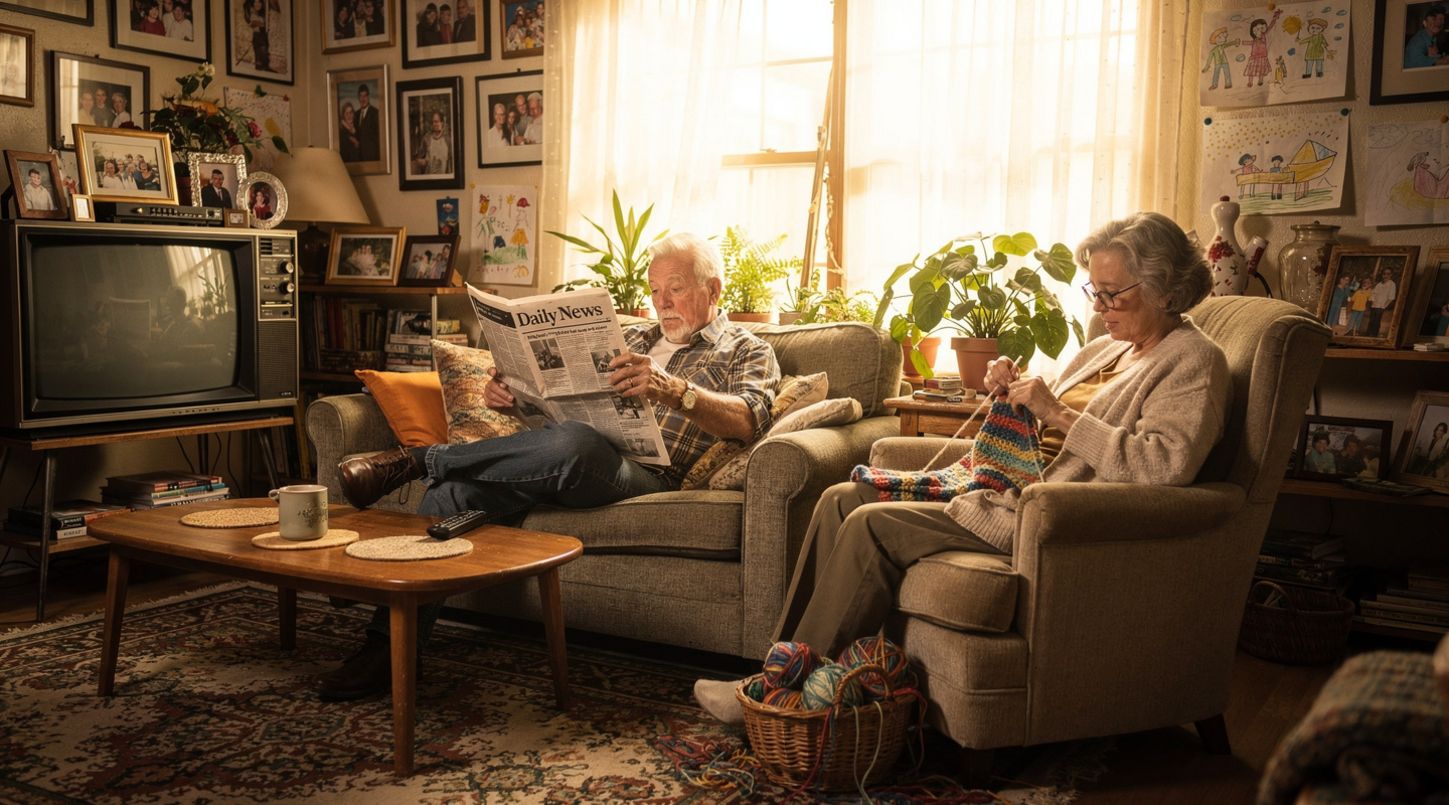
I’ve spent more time than I care to admit sitting in living rooms across America, and there’s something oddly fascinating about what people choose to keep on display. Not the trendy Instagram-worthy stuff—I’m talking about the real things, the objects that have been there for decades, quietly telling a story.
You know what I mean? Walk into someone’s home and before they even say hello, the room is already speaking. There’s a language in these choices, and I’ve come to realize it’s especially true for working-class boomers—a generation that lived through genuine cultural shifts, economic changes, and technological leaps that shaped how they see permanence and value.
What gets me is that most people don’t even realize how much these choices reveal. A psychologist would probably say we’re all engaging in environmental storytelling—using our spaces to communicate identity, values, and history. But it’s more intimate than that.
I’ve watched families sit around living rooms filled with these objects, and nobody ever talks about why they’re there. They just… are. Here’s what I’ve found.
1. The Sofa That’s Seen Three Decades
There’s this couch in my aunt’s living room. It’s been there since 1987. I know this because she tells me every single time I visit, though I think she’s more talking to herself than to me.
It’s a cream-colored sectional—or it was cream-colored. Now it’s this muted beige that comes from years of sitting, sun exposure, and the kind of living that doesn’t come from careful maintenance. The fabric is worn in certain spots, smooth in others. There are throw pillows trying their best to hide some of the damage, but honestly, they’re losing the battle.
Here’s the thing though: she’ll never get rid of it. Not because she can’t afford a new one, but because that sofa represents something. It’s functional. It works. Why replace something that works?
Research suggests that generational attachment to objects often stems from scarcity mindset—even when scarcity is no longer present. For working-class boomers who grew up during economic uncertainty, an item that still functions is an item worth keeping. There’s a quiet pride in that.
It’s not laziness or lack of taste, the way younger generations might assume. It’s a completely different value system.
2. The Ceramic Figurines and Collectibles Arranged Just So
Walk into almost any working-class boomer’s living room and you’ll find them: the shelves lined with small treasures. Ceramic cats. Figurines from vacations taken in the 1970s. Commemorative plates from the Royal Family or from some state fair from thirty years ago.
I asked my neighbor about hers once—dozens of porcelain shepherdess figurines covering an entire bookshelf. She got quiet for a moment, then told me she used to collect them with her mother. They’d go to estate sales together on Saturday mornings.
That’s when it clicked for me. These aren’t just decorations.
They’re memory anchors. Each one connects to a specific moment, a relationship, a time when life felt different. Psychologists understand this as nostalgia-driven consumption—we keep objects around us that help us access emotional memories. For boomers, these figurines are conversations with the past, with people they’ve lost, with versions of themselves they remember fondly.
The arrangement matters too. It’s deliberate, meticulous. Everything has its place.
3. The Plastic Covering on the Lamp Shades
I’ve never understood this one, but once I stopped judging and started asking, I finally got it.
You know what I’m talking about—lampshades that still have their original plastic protective covering, years after purchase. It’s yellowed, it’s dusty, but it’s still there.
This isn’t about laziness or forgetfulness. I’ve learned it’s actually a form of protective stewardship. If you grew up in an era where “nice things” were meant to last, where you didn’t use the good china because it was for someday, then keeping things in their original state feels safer. It preserves them. It keeps them from wearing out, from being used up, from becoming ordinary.
There’s something almost poignant about that logic, isn’t there?
Related: Why nostalgia shapes how we decorate and what we keep
4. The Television as the Room’s Central Fixture
Not a subtle flat-screen mounted on the wall. I mean the television as furniture—as the absolute gravitational center of the room.
Every seating arrangement faces it. Conversations curve around it. If the TV is on, that’s what’s happening; if it’s off, there’s an almost awkward silence until someone switches it on.
I visited my dad’s place last month, and his living room is essentially built around his TV. The couch, the chairs, even where people stand—it all orients toward those 48 inches of screen.
This speaks to something about companionship and contextual entertainment. For many boomers, the television was the first real window to the world beyond their town. It brought entertainment, news, and connection into the home. It still does. Behavioral researchers have found that this generation often uses television as ambient social presence—it fills the room, keeps loneliness at bay, creates a sense of activity even when you’re sitting alone.
There’s no shame in that at all.
5. The Wall of Family Photographs in Mismatched Frames
These are never organized by date or by aesthetic principle. They’re organized by meaning.
The wedding photo from 1972. The baby picture of whoever this is. Grandchildren at various ages. School photos. A random vacation snapshot from somewhere that looks like it could be from any decade.
The frames don’t match—some are gold, some are plastic, some are actual wood. Some have mats, some don’t. By interior design standards, this should be chaotic. But it isn’t.
It’s a visual autobiography, and that matters more than cohesion.
Psychologists call this identity documentation—the human need to see ourselves reflected back, to have visual proof of relationships and milestones. For working-class families, especially those without extensive travel or consumption as part of their identity, these photographs become the record of a life well-lived. The variety of frames actually adds to this effect. Each one shows its own history, its own era of acquisition.
Walking past that wall, you’re reading someone’s love language written in pictures.
6. The “Good” Furniture Never Really Sat On
Every boomer living room has something like this.
There’s the furniture that gets used—the worn couch, the recliners with permanent body-shaped indentations. And then there’s the other furniture. The formal seating that stays pristine because it’s reserved for guests or for “special occasions” that somehow never quite arrive.
I had a friend whose grandmother kept a formal dining room furniture set that had never been fully used in twenty years. The chairs still had their original plastic protectors. Holidays were spent eating TV dinners on folding tables rather than using that beautiful set.
I used to think this was sad. Now I understand it differently.
This is about aspirational preservation. When you grow up with less, when you work hard to acquire something “nice,” the protective instinct is almost automatic. Keeping something pristine means keeping it valuable. Using it means risking its deterioration. For many working-class boomers, nice things were meant to last forever—to prove that their hard work was worth something.
The irony is that the furniture usually does last forever, just unused.
7. The Knick-Knack Shelves Dusted Religiously
You cannot walk into a boomer’s living room without noticing the shelves.
Not bookshelves, necessarily—though there might be some books. I’m talking about shelves dedicated entirely to objects. Small glass animals. Wooden boxes. Miniature lighthouses. Souvenir spoons from every state visited. Carnival glass. Salt and pepper shaker collections.
These shelves are dusted. Not occasionally—regularly. With intention.
The care taken with these objects tells you something about how this generation values time, ritual, and attention. There’s a meditative quality to dusting a collection. You pick up each object, notice it, remember where it came from or why you like it, set it back down.
Researchers in gerontology have found that ritualistic object care actually provides psychological benefits—it creates routine, purpose, and connection. For people who may have retired or whose daily structure has changed, these rituals matter. They’re not tedious—they’re stabilizing.
Every object gets touched. Every object matters. Every shelf tells a story about patience and presence.
Final thoughts
Walking through a working-class boomer’s living room isn’t just seeing furniture and objects. You’re seeing a philosophy about permanence, value, and what deserves to be kept.
If you recognize your own living room in any of these descriptions, you’re not outdated or stuck. You’re honoring a set of values that actually run pretty deep—that good things last, that relationships matter more than aesthetics, that memory is worth more than newness.
The next time you’re in one of these rooms, look closer. Every object is saying something about who these people are and what they’ve chosen to hold onto. That’s not nostalgia for nostalgia’s sake. That’s love made visible.